We’ve recently completed the the first phase of our development of Fluence-Field-Modulated Cone-Beam CT (FFM-CBCT) system —
it began as a simulation framework and then evolved into a full benchtop implementation. We built and validated:
- Implementation & simulation on our GPU-accelerated Monte Carlo platform (GPUMCI);
- Benchtop demonstration of dynamic fluence control with a rectangular collimator;
- Processing pipelines to compensate for fluence-dependent intensity variation in reconstruction;
- Scatter-reduction and correction methods to recover uniform image quality at reduced dose.
Together, these established a baseline FFM-CBCT system capable of selective dose shaping and region-of-interest imaging.
I completed B.Math in Mathematical Physics with minors in Computer Science and Pure Math at the uWaterloo (2024). Joined UHN (Princess Margaret Cancer Centre) and worked with Dr. G. Bootsma on FFMCBCT as a co-op and returned full-time after graduation.
Right Now
We’re extending the FFM-CBCT platform by linking simulation + benchtop into a single framework
capable of retrieving the material properties of scanned objects directly from measured data.
This combined approach could allow quantitative imaging for proton therapy and stereotactic radiosurgery, where knowing a tissue’s true composition and location means tighter range prediction and more accurate dose delivery.
Earlier threads
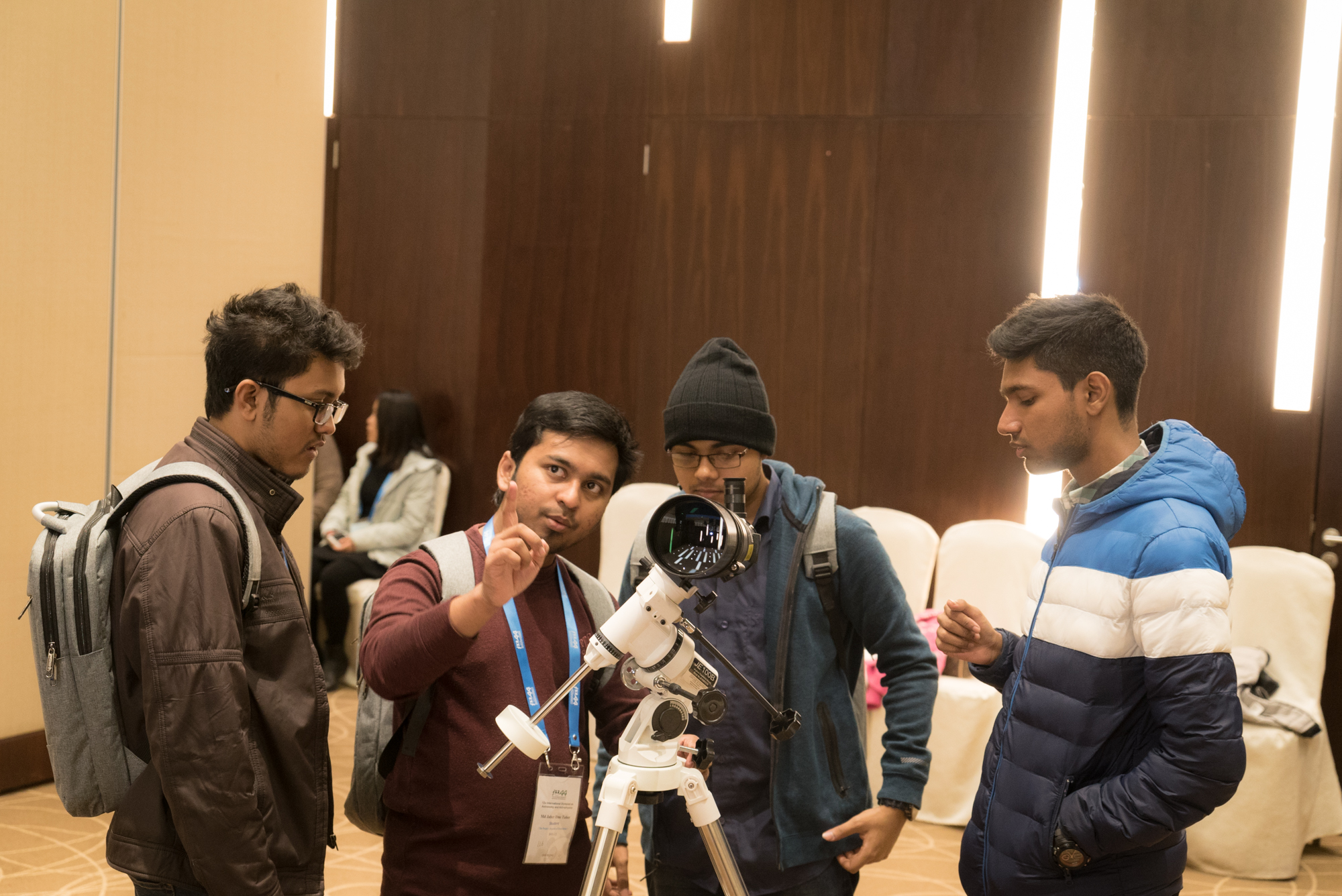
In high school I was active with BDOAA and represented Bangladesh at IOAA 2018. It was a lot of night skies, problem sets, and lifelong friends. Good ol’ times.